
January Was Never Meant to Be a Beginning
History, winter, and why so many women feel behind before the year even begins.

The room is quiet in a way that only January insists upon. Outside, the trees are stripped back to bone, the light arrives late, slants low, and leaves early again, as if it has somewhere else to be. The world feels held, paused, unfinished.
And yet, everywhere I look, women are being told to begin. New goals, new offers, new habits, new energy. The tone is clear; start the new year already.
I keep meeting a woman who feels faintly confused by this. She tells me she should be excited, motivated, and grateful for the clean slate. But her body does not recognise January as a beginning, it recognises it as something else entirely.
A holding pattern.
A waiting room.
A season for keeping the fire lit, leaning in and not much more.
She wonders, quietly, if there’s something wrong with her.
There isn’t.
What’s wrong is the calendar.
Hi lovely, just a quick one…if you’re enjoying this newsletter so far, then please do share it with your network. It’s one of the simplest and kindest ways to support my little corner of the internet and keep these letters coming.
Long before January became the doorway to a “new year,” it wasn’t a beginning at all.
In early Roman time, the year began in March, when the earth softened and the work of planting could begin. Winter barely counted as time, it was an in-between. A pause. A necessary stillness after harvest, before growth.
January only took its place at the start of the year because of politics, power and administration. Roman consuls needed a tidy moment to take office, and so the year was bent around bureaucracy rather than land. January was named after Janus, the two-faced god of thresholds, looking backwards and forwards at once. A fitting symbol for a month that belongs fully to neither rest nor renewal.
Even then, this idea travelled slowly. In Britain, the new year did not officially begin in January until 1752. Before that, it arrived in spring, around Lady Day in March. Farmers settled accounts between ploughing and planting. Contracts renewed when the soil itself was ready to receive something new. Time made sense because it followed the body of the land, only later did we ask winter to behave like spring.
Nature, of course, has never agreed to this arrangement.
In winter, fields lie fallow, trees withdraw their energy underground, animals sleep more, light reduces, growth is not visible, because growth at this stage is not the point. Even our bodies know this; we sleep longer in winter, we move more slowly, our nervous systems lean toward conservation, not expansion. This is not a flaw, it’s a symbol of our connection to nature, animals and our ancestors.
And yet modern business culture treats January like a starting gun.
Hit the ground running, launch now at all costs, plan the year, do your vision-board, decide everything. Go, go, go! No wonder so many women feel behind before the year has even properly begun. It’s exhausting.
If you know me, you’ll know I’m obsessed with period dramas and historical fiction, which led me to thinking about women in other winters, previous winters that fell before us, and invariably the winters that will come after us:
1. The medieval woman by candlelight
She sits close to the hearth, not because she is cold, but because light is precious.
The candle has already been trimmed once today, she knows how long it will last. She always knows. Winter teaches this kind of attentiveness. Outside, the snow presses against the stone walls as if listening, the wind finding every weakness in the mortar. Inside, the house hums with stillness; no fields to tend, no planting to begin. The land is impenetrable for now.
In her lap, a broken tool. The handle worn smooth by years of use. She turns it slowly, checking the grain of the wood, the place where it cracked. Repair is careful work. It asks for patience, not ambition. She does not rush, for there is nowhere to rush to.
Her fingers ache slightly, but she keeps going. This is the season for mending what survived the year. Tools, clothes, relationships, and memories. She thinks back over the harvest, what worked, what didn’t, and lingers on who is gone and who will return when the roads clear once again.
She does not feel behind.
Winter has given her permission to pause, to gather herself inward. To know herself. Beginning would make no sense here, nothing will simply grow yet.
2. The craftswoman with her needles
Her needles are laid out in a careful row, sorted by size, their tips catching the low light.
She sharpens them one by one, drawing each across the stone with a practised rhythm. She counts without meaning to. This many left, this many still strong enough to use, this one too thin now, set aside. Inventory, but not the modern kind. Not numbers for growth, but for knowing what remains.
The day is short, by mid-afternoon, dusk begins to creep across the room. She lights a lamp and moves closer to the table. Winter compresses everything; space, time and expectations.
There is no new work coming in, no orders waiting. Yet, she is not anxious about it. This is the season when hands slow, when skills deepen rather than expand. She repairs garments brought back after months of wear, reinforces seams, reworks pieces that didn’t quite hold last year.
Later, neighbours will gather. Someone will bring bread, someone will tell a story she’s already heard twice, children will drift in and out, half bored, half comforted by the familiarity of it all. Stories pass the long evenings because stories are how knowledge moves when nothing else can. Who married whom, who overreached, who survived a hard winter before. These are not distractions, they are lessons passed on from generation to generation.
Winter is not for novelty, it’s for remembering what endures.
3. The woman who keeps the ledger
She keeps accounts at the small table by the window, wrapped in wool, breath visible when she pauses. The ledger is thick, its pages bear the marks of a year lived fully. Payments made, debts settled, favours exchanged and losses noted without demand.
She runs her finger down the columns, murmuring numbers under her breath, not because she is worried, but because this is how she closes a cycle. Outside, the fields are empty. Inside, the year is being put to rest.
She does not plan yet, planning belongs to spring. What she does now is reckoning. Taking stock. Asking herself what can be carried forward and what must be left behind.
Some ventures will not return. Some ideas were right for the moment and no longer. She accepts this without shame. The ledger does not judge her, it only tells the truth.
When she finishes, she closes the book and ties it with ribbon. There is relief in this act, completion has weight. It signals that nothing more is required of her tonight.
The year is finished, beginning will come when the light returns.
4. The woman in a future winter
She wakes before the light, because the light is no longer a reliable marker of anything.
Her wrist whirs softly, already tallying her sleep, her readiness, her projected output for the day. A screen blinks encouragement at her. You’re 82% primed for performance. She feels none of it.
Outside, it should be winter. The air still bites, the trees are stripped bare, and yet the season feels unreliable, as if it might change its mind at any moment. Inside, the house is warm, bright, optimised. There is no dimness anymore, no natural slowing. Everything is adjustable now.
She sits at her desk in thick socks and starts three things at once. A strategy document, a voice memo and a message thread marked “urgent” even though nothing is actually on fire. She drinks something labelled “focus,” then something labelled “calm,” because the first one worked too well and now she feels the familiar humdrum of anxiety rising in her chest.
Her body keeps sending small, polite signals. A stiffness in the shoulders, a fog in her mind that no amount of supplement, medication or health tonic will cure, and a strange ache in her jaw. She ignores them. There’s a January plan to execute and simply too much to do, a new cycle to initiate, a promise she made to herself back in December for her “best year yet”, when the lights were still on and the year felt negotiable.
By mid-morning she has opened and closed the tabs on her virtual screen more times than she can count, reorganised her task list, downloaded a short video about rest and bookmarked it for later. Ha! Later she will rest.
Outside, the world should be resting. The birds are quieter, the ground meant to be closed, but the seasons no longer arrive cleanly. Winter stutters, spring comes too early, or not at all. Even the land seems unsure what it’s meant to do next.
Later, she will wonder why she feels hollow, why everything feels harder than it should, why she can’t remember the last time she finished something properly before moving on to the next thing. It won’t occur to her, not yet, that the problem isn’t her discipline. It’s that she’s living inside a man-made world filled with artificial light and distraction, forgetting the very essence of what winter is about.
When I imagine a different way of working, it does not look radical, it looks ancient.
Not ancient in terms of tools and going back to writing with a quill and ink, but winter becoming a quiet quarter, a season of maintenance, reflection, gentle thinking, less visible work, more inward attention, and a time to close loops rather than open new ones.
Spring then becomes the true beginning, the moment when the ideas that rested all winter finally have somewhere to go. Launches make sense here, planning feels alive, and energy rises because the world itself is rising.
Summer grows what spring began. There is effort, yes, but also ease. Long days, collaboration, flexibility, and celebration alongside labour.
Autumn gathers the harvest, focus sharpens, work completes, value is realised, and then, crucially, things end. Projects close, books are balanced and the cycle prepares to turn again.
Nothing blooms forever, but then nothing in nature was ever meant to. Even you.
And this is where marketing quietly enters the room.
Marketing for small businesses has never really been about tactics, it has always been about storytelling. About the worlds we invite people into, the meanings we help them feel, the trust we build through alignment, meaning and care. A craftswoman before the industrial revolution did not sell by shouting. She sold through reputation, continuity, craft, and word carried carefully from one person to another. Today, we do the same, just with different tools. Our websites are rooms, emails are letters and customer journeys are stories unfolding over time.
When we rush, when we mimic urgency that doesn’t belong to us, the magic thins. But when we work with rhythm, with season, with imagination, we give people something rarer than optimisation; we give them a place to land.
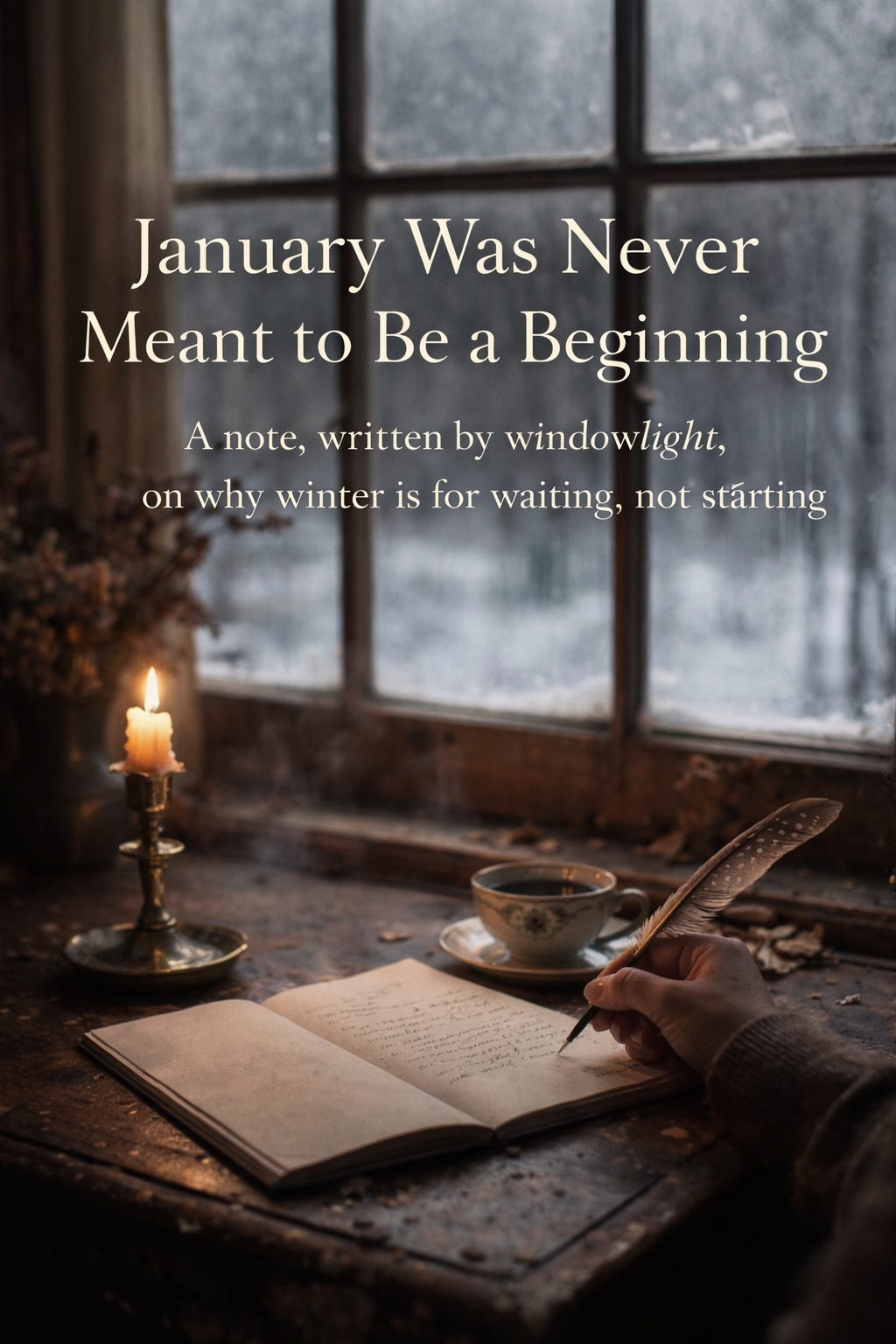
So here’s the question I’ll leave you with, written softly, by window light.
Where will you take your audience next?
What world will you invite them into? What pace will you set? What story will they feel themselves inside of, long after they’ve closed the tab?
Because the businesses we remember are never the loudest ones, they’re the ones that made us feel something.
So, perhaps this year does not begin in January after all.
Perhaps it’s still winter, where we negate the need to feel on time, behind or hurried, the seeds are doing exactly what seeds do. Waiting. So we will wait too. And when the light returns, when the ground softens, when our bodies says yes again, we will too.
Not because a calendar told us to, but because the season did.